
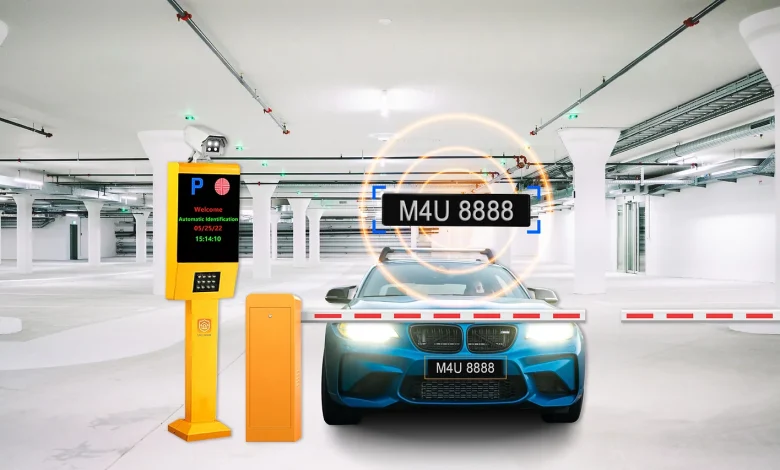
License plate recognition (LPR/ANPR, sometimes also referred to as *reconocimiento de matrículas*) is a way to automatically identify vehicles, so your access control no longer has to wait for a badge, an intercom, or a manual check. Instead, you let access move with the traffic: a car arrives, the plate is read, the rule is applied, and the entry point responds.
If you want to see what that can look like in practice, the Nedap license plate recognition system is a concrete example within the broader landscape of ANPR solutions for vehicle identification and security integrations.
What technically happens in automatic license plate recognition
An ANPR chain roughly consists of image capture, image optimization, and text extraction. Cameras deliver frames in which software first locates the license plate. Then comes normalization: correcting for perspective, motion blur, reflections, and changing lighting conditions. Only after that does OCR kick in: the engine converts pixels into characters and often includes a confidence score.
And real-time *lectura automática de placas* isn’t just about speed, it’s also about handling uncertainty intelligently. A solid system can deal with variations in fonts, countries/formats, and partial occlusion without immediately falling back on manual verification.
Accuracy in challenging conditions
The precision of *lectura de matrículas* (OCR) depends heavily on your boundary conditions: shutter speed, IR illumination, viewing angle, mounting height, and the expected vehicle speed. Nighttime, rain, and dirty plates are more the norm in the field than the exception. That’s why many systems use multiple frames or filtering to determine the single most reliable read.
Access control that reacts to traffic instead of the other way around
The real win is in the connection to your access logic. Instead of the driver having to do something, you let the system decide based on identity (license plate) and context (time, zone, direction, status). That’s what makes integration with barriers and gates (*control de acceso vehicular*) suddenly very practical: recognition triggers, and the access controller enforces your policy.
You can see this as an extra identity layer alongside badges and mobile credentials. For visitor management and logistics, that’s ideal, because you can steer who’s allowed in when using whitelists/blacklists and exception rules without your traffic flow taking a hit.
Integrations with security ecosystems
ANPR almost never stands alone. In modern environments, you connect it to CCTV/VMS for context, to alarms for incident workflows, and to logging for audit trails. Real-time alerts then aren’t just a heads-up to “take a look,” but an automatic step in your process: detection, classification, action, and registration.
Edge, cloud, and the security and privacy layer you can’t afford to forget
Where you run recognition (edge processing vs. cloud) determines your latency, operational overhead, and risk profile. Edge gives fast response and often makes data minimization easier, because you don’t necessarily have to move video streams around. Cloud, on the other hand, is useful for centralized management, analytics, and rolling out consistent policies across multiple sites.
Privacy and compliance (GDPR) mean you should treat license plate data as personal data as soon as the context makes it identifiable. Think purpose limitation, minimal retention, clear retention periods, and strict access rights. And don’t forget cybersecurity: cameras and controllers sit on your network, so set up segmentation, hardening, updates, and limit management interfaces. That way, access that moves with traffic stays not only fast, but also manageable and secure.


